

Should Retirement Planning for Military Members Begin at 40?

Blue Collar Dollar connects working people with Talon, LLC advisers for retirement guidance. Your retirement planning for military service should begin well before 40, when service starts. Earlier preparation gives you more time to save and understand how benefits fit.
However, reaching 40 without a plan does not mean you have missed an opportunity. Start now by comparing expected retirement income with future expenses. For Florida military families, that review can help frame decisions about civilian employment before the final military paycheck arrives.
Key Takeaways
- Begin retirement planning early in your military career and update it as circumstances change.
- Starting at 40 still offers time to review savings, adjust goals, and plan future employment.
- Confirm pension eligibility, TSP contributions, and when military retired pay can begin.
- Compare expected income with housing, health care, taxes, and other transition expenses.
- Review an adviser’s experience, services, fees, and potential conflicts before committing.
When Should Retirement Planning for Military Members Begin?
Start with the first military paycheck, then update the plan as your career changes. Someone who enters at 18 could complete 20 years of active service at 38. Waiting until 40 could therefore mean planning after military retirement, when some benefit choices have already taken effect.
Your savings need time to develop. Starting earlier allows more contributions and more time for potential investment growth, although losses remain possible.
Formal transition preparation follows a separate timeline. Initial and pre-separation counseling generally must occur at least 365 days before departure. Retirees should begin the transition process at least two years ahead.
How Does the Right Starting Point Change With Your Situation?
Your service timeline matters more than a birthday. Use the milestones below to decide what needs attention now.
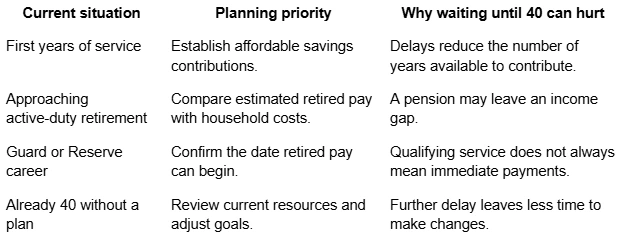
Which Military Benefits Deserve an Early Review?
Your retirement system determines which benefits apply. Confirm the applicable rules with your personnel office before treating any estimate as money available to spend.
- Check pension eligibility. Regular active-duty retirement generally requires 20 years. Medical retirement follows different rules, so avoid assuming every departure produces monthly retired pay.
- Review BRS contributions. Under the Blended Retirement System, eligible members can receive government TSP contributions. Matching depends on their own deposits and applicable service requirements.
- Confirm Reserve timing. Reserve retired pay generally begins at 60 after 20 qualifying years, although qualifying service can reduce that age.
These distinctions make retirement planning for military households more accurate.
For additional background, read FINRA’s guide to understanding your Thrift Savings Plan.
What Should Someone Starting at 40 Do First?
Your first goal is a workable plan based on facts. Trying to make up lost time through aggressive investments can expose needed savings to larger losses.
- Measure the gap. Compare expected monthly spending with reliable income estimates. Use the amount remaining after deductions, rather than the headline pension figure.
- Choose sustainable contributions. Set a savings amount that fits your budget. Increase it when income permits without leaving essential expenses uncovered.
- Revisit the work timeline. Consider whether a civilian job could support current bills while retirement savings remain invested.
Review progress regularly, after a household change or employment offer.

Which Florida Transition Costs Should Enter the Budget?
Your civilian budget should reflect where you will live. Florida does not impose personal income tax, but federal tax obligations may still apply.
- Price housing locally. Obtain current insurance quotes before choosing a home. A lower purchase price does not automatically mean lower monthly ownership costs.
- Confirm health coverage. Review the coverage available after departure and its costs. Include the amount your household may need to pay directly for care.
- Allow for employment delays. Keep accessible funds before civilian wages begin. Retirement account withdrawals before 59½ can trigger additional tax unless an exception applies.
How Can Blue Collar Dollar Support a Retirement Income Plan?
Our retirement planning services connect pension income with personal savings. Through Talon, LLC advisers, Blue Collar Dollar serves military members, veterans, and tradespeople.
For someone considering a second career, the useful question is how employment income changes withdrawals from savings. Ask the adviser to explain the assumptions behind the proposed plan.
Additionally, retirement planning for military families should account for changing household needs. A spouse may return to work or reduce paid hours. Discuss how the plan would respond before relying on a single income estimate ahead.
How Should You Assess the Advisers Behind the Service?
Blue Collar Dollar is a trade name of Talon, LLC, which provides advisory services. Your evaluation should focus on the proposed adviser.
Ask about experience with military benefit decisions. Request the firm's Form ADV brochure and review the services covered by the engagement. Confirm any professional designation through its issuing organization before relying on it.
You should understand the total fees before signing. Review the website’s frequently asked questions, then request details about the fees and services proposed for you. Ask how compensation could affect recommendations, including any proposed account transfer. An explanation helps you assess whether the relationship fits your needs without assuming credentials guarantee a successful outcome.
Start Your Military Retirement Plan With Blue Collar Dollar
Contact Blue Collar Dollar to discuss retirement planning for military life and the transition ahead. Our website states that advisers work with clients who have at least $250,000 in investable assets; availability varies by state.
Before the conversation, note your concern about retirement. Ask what the proposed engagement includes and which decisions require help from a military benefits counselor.
Before submitting personal information, review Blue Collar Dollar’s privacy policy.
Investing involves risk, including loss of principal, and planning cannot guarantee results. Talon does not provide tax or legal advice. Consult your own professionals for those matters before acting on a proposed strategy.
Frequently Asked Questions
Q: Is 40 too late to start?
A: No. Starting at 40 still allows decisions about savings and future work, although the right approach depends on existing resources and retirement goals.
Q: Does leaving the military mean receiving a pension?
A: No. Ordinary active-duty retirement generally requires 20 years of service. Leaving earlier usually does not provide that pension, while medical retirement follows separate rules. See the Department of Defense’s active-duty retirement overview.
Q: Can Reserve members receive retired pay at 40?
A: Usually not. Reserve retired pay generally begins at 60 after 20 qualifying years, although certain qualifying services can lower the payment eligibility age.
Q: Does a military pension replace all earnings?
A: No. Military retired pay uses the applicable retirement formula. Compare the estimated amount after deductions with household spending before deciding whether additional work is necessary.
Q: Must military families hire a private adviser?
A: No. Families can use available military financial counseling. Private advice may help with broader needs, but compare its scope and fees before making a commitment.