

How Much Do Retirement Plans for Contractors Pay Off?

Ever wonder how well retirement plans for contractors profit on average? Truth be told, it depends on your contributions and investment results after fees. Investments can lose value, which might delay your retirement plans.
You can also use these accounts to save money separately from your business, although any tax advantages will depend on your individual circumstances. For contractors in Florida, the primary aim is to have funds available to cover your living expenses when work slows down or ceases. When choosing an account, it's important to consider how your company earns its income and whether or not you have employees.
Blue Collar Dollar helps working people connect with Talon, LLC advisers for advice on contractor retirement plans.
Key Takeaways
- Your retirement account balance depends on contributions, withdrawals, investment performance, and fees. Investment returns are not guaranteed.
- The target payoff should cover the exact gap between your expected retirement living expenses and Social Security income.
- Eligible deductible contributions may reduce current federal taxable income. Roth contributions do not provide a current deduction, and tax treatment depends on your circumstances.
- Your maximum savings potential is dictated by IRS limits tied to your specific plan type, such as a Solo 401(k) or SEP IRA.
How Much Income Should Contractor Retirement Plans Replace?
To figure out how much to save, look at your future income gap. For example, if you expect to spend $4,000 a month in retirement and Social Security pays $2,500, your savings need to cover the remaining $1,500 each month, or $18,000 a year, before taxes on withdrawals.
You should also estimate how long your savings need to last. Retiring at 60 may require more savings than retiring at 67 because your withdrawals could need to cover more years. If you stop working before you qualify for Medicare, remember to include health insurance costs.
Be careful when counting on selling your business. The price can change, and it might not be easy to find a buyer.
How Much Can Monthly Deposits Add Up To?
If you save $1,000 each month, you’ll put away $12,000 a year. The table shows how deposits add up at two savings levels, starting at age 35 with no initial balance.
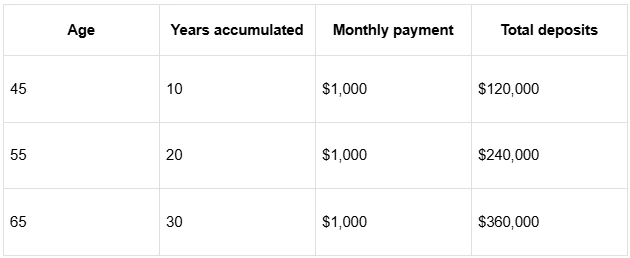
These totals assume you don’t make any withdrawals. They don’t include investment gains, fees, or inflation. Your actual balance could end up higher or lower.
Compounding means invested earnings can generate further earnings. However, growth depends on market conditions. A calculator's assumed return is neither a fixed payout nor a forecast of Talon's results.
What Retirement Accounts Should Contractors Consider?
Start by checking whether a plan covers only the owner or also the crew. Then, consider the following:
- Solo 401(k): Owners without eligible employees beyond a spouse can contribute as employee and employer. The 2026 caps are $24,500 for employee deferrals and $72,000 combined, before catch-ups.
- SEP IRA: As an employer, you usually have to contribute the same percentage for all eligible employees. The cost of covering your crew can affect whether this plan is affordable.
- IRA: Traditional and Roth IRAs share a $7,500 contribution limit for someone under 50, subject to eligibility.
Your maximum contribution depends on eligible income and IRS rules. If you are 50 or older, catch-up contributions may be available for an IRA or a 401(k) that permits them. Catch-ups do not increase the SEP employer contribution limit.”
How Much Can a Tax Deduction Really Save?
The amount that contractors contribute to retirement plans may reduce their federal taxable income. For example, if $20,000 is contributed fully and is deductible, it could result in a decrease in federal income tax of $4,800 on the assumption that each dollar deducted would have been taxed at a rate of 24%. However, other deductions can affect the outcome.
For a sole proprietor, deductible contributions for your own retirement generally go on Schedule 1 and do not reduce self-employment tax. Employer contributions for eligible employees may be deductible on Schedule C, subject to IRS limits.
Because Florida does not have a personal income tax, this example focuses on federal income tax.

How Can You Save During Uneven Work Months?
A cash reserve allows you to keep your daily expenses separate from your long-term savings, and you may deposit money into your contractor's retirement plan according to the income you earn, provided that you adhere to the plan's rules.
- Set aside money for taxes before deciding how much to put into your retirement plan.
- Choose a regular deposit amount you can still afford, even if work slows or jobs are delayed.
- After a good quarter, you can add more money to your plan, as long as you’re eligible and stay within the yearly limits.
- Keep some cash on hand for equipment repairs, so you don’t have to take money out of your retirement plan early if something breaks.
Taxable withdrawals from a traditional IRA or 401(k) before age 59½ generally face an additional 10% federal tax unless an exception applies. Regular Roth IRA contributions can generally be withdrawn without tax or penalty.
What Does Blue Collar Dollar Help Contractors Coordinate?
At Talon, our advisers look at how your pensions and personal savings fit into your retirement income plan. We also help with Social Security timing and insurance needs. If you plan to stop working early, you can talk with us about your options.
Your spouse might have a teacher pension or retirement benefits from military service. These payments can change how much you need to save through your contracting business. Our Talon advisers may provide a written financial analysis, depending on the scope and terms of your engagement. A tax professional should check which deductions your business can use.
What Should You Check About the Firm and Adviser?
Talon, LLC offers advisory services as Blue Collar Dollar. Its Form CRS shows it is registered with the SEC as an investment adviser. Registration does not mean the SEC endorses or guarantees their skills.
- Find Talon's record under CRD 298714 in the SEC's Investment Adviser Public Disclosure database.
- Look up your adviser’s registration and work history. Remember, one person’s credentials don’t cover the whole team.
- Read the firm’s Form ADV and relationship summary before you sign any contract. Ask about ongoing fees and any conflicts of interest mentioned in those documents.
Discuss Your Contractor Retirement Goals With Blue Collar Dollar
Talon waives the first financial planning fee for eligible applicants, but ongoing advisory services have fees. We help tradespeople connect with advisers at Talon, LLC, which is an SEC-registered investment adviser. Submit our website form to request an introduction.
Your loan balances and interest rates can help us understand your savings budget. We invite you to fill out the introduction form on our website. Make sure you know the scope of work and fees before you decide to move forward.
Contact Blue Collar Dollar at (352) 751-3200 to discuss contractor retirement plans and see whether their advisory services are right for you. Bring your current account statements to your first meeting, along with an estimate of your business income and your latest Social Security statement.
Frequently Asked Questions
Q: Can a contractor save while working a W-2 job?
A: As a contractor, you can use a separate business retirement plan, but 401(k) employee deferrals usually have one annual limit across all plans. Employer contributions have their own set of rules.
Q: Can the owners of an S corporation make use of business distributions as a means of contribution?
A: S corporation distributions do not count as retirement plan compensation. Contributions generally rely on eligible W-2 wages, so salary choices affect contribution capacity.
Q: Should contractors choose traditional or Roth contributions?
A: Traditional contributions may provide a current deduction. Roth contributions generally use after-tax money, with qualified withdrawals tax-free. Eligibility and your expected tax rate matter.
Q: Does the Solo 401(k) have to be filed annually?
A: A Solo 401(k) generally requires Form 5500-EZ when combined assets across the employer’s one-participant plans exceed $250,000 at year-end. Final-year filing is required regardless of assets.
Q: Can a spouse without earnings have an IRA?
A: Possibly. If you file jointly and have enough combined compensation eligible for IRA contributions, each spouse can fund a separate IRA. Contribution limits and applicable income rules still apply.